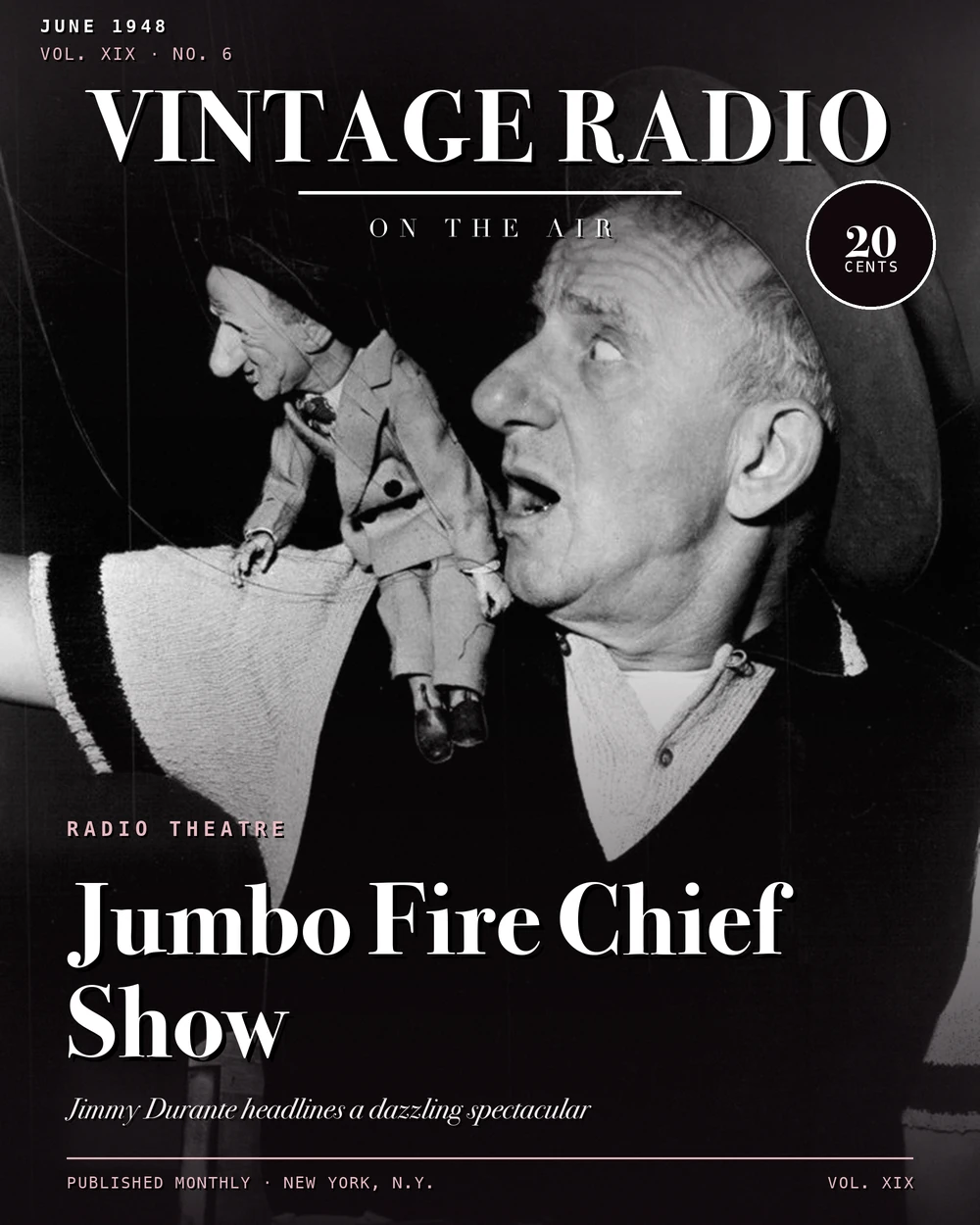
Jumbo Fire Chief Show
Radio as a Publicity Stunt
The Jumbo Fire Chief Show was not quite like any other program NBC put on the air in 1935. It was, at its core, a promotional vehicle — producer Billy Rose's scheme to generate national buzz for his stage extravaganza before the curtain even went up at the New York Hippodrome. Rose hired Charles MacArthur and Ben Hecht to write the book, Richard Rodgers and Lorenz Hart to write the score, and Jimmy Durante to anchor the cast. He booked the Texaco Fire Chief half-hour that comedian Ed Wynn had just vacated, and on October 29, 1935, the show went out over the NBC Red Network from WEAF in New York. The radio program opened two full weeks before its companion stage show, which meant that when the Hippodrome's doors finally swung wide on November 16, 1935, much of the country had already spent three Tuesday evenings inside the story.
Rose conceived the radio show explicitly to broadcast songs and dialogue from the stage production — some drawn directly from the script, some freshly written for the air. Because the stage show's opening was repeatedly delayed during final rehearsals, those early radio broadcasts captured portions of the Rodgers and Hart score that were later cut before opening night. Songs that would otherwise have gone unheard made it to a national audience through the radio run. That's a curious footnote: the radio show, for all its troubles, became something of an inadvertent preservation record of material that never survived to the stage. A scholarly article in The Musical Quarterly (Vol. 89, 2006), titled "'Bigger Than a Show — Better Than a Circus': The Broadway Musical, Radio, and Billy Rose's Jumbo," examined precisely this aspect of the show's significance.
The Cast and Crew Rose Assembled
The weekly budget was $15,000, and Rose spent it. The show featured animal acts, aerialists, a 35-piece orchestra, and a 32-voice male choir. That choir, Charles Henderson's Razorbacks, was the same ensemble that performed in the stage production — Rose kept the personnel continuous across both properties.
Jimmy Durante played Claudius "Brainy" Bowers, a comical press agent working for the down-on-his-luck Considine Wonder Circus. Durante had made his radio debut on NBC's The Chase and Sanborn Hour on September 10, 1933, and had served as substitute host there from April through September 1934 before taking the Jumbo role. His character's signature move was scheming to save the circus each week, watching his plans backfire, and seeing the circus survive by the narrowest margin — only to face the same peril the following Tuesday. His signature theme song, "Inka Dinka Doo" — a novelty composition with lyrics by Ben Ryan that he had recorded as a hit by 1934 — was part of his persona coming into the show.
Gloria Grafton played Mickey Considine, daughter of the beleaguered circus owner, and Donald Novis played the aerialist Matt Mulligan, Mickey's beau and the son of her father's bitter rival. Arthur Sinclair took the role of John A. Considine himself, though in a notable quirk of the radio adaptation, Considine was mentioned in nearly every episode but was never heard at the microphone. W. J. McCarthy played Matthew Mulligan, owner of the rival and more prosperous Mulligan circus. Adolph Deutsch led the radio orchestra — a musician who had trained at the Royal Academy of Music in London from age eight, emigrated to the United States in 1910, and worked as an arranger and musical director in New York and Chicago through the 1920s before joining the Jumbo enterprise. Deutsch had previously orchestrated Broadway productions for Gershwin, Irving Berlin, and Rodgers and Hart, and served as musical director for the stage production as well. Louis Witten announced.
Paul Whiteman was musical director for the stage show, but contractual conflicts kept him off the air, leaving Deutsch to carry the radio side alone.
The Score and the Songs
Rodgers and Hart's score for Jumbo was, by contemporary assessment, among the strongest musical work of 1935. Stanley Green, in Ring Bells! Sing Songs! — his history of 1930s musicals — wrote that "Rodgers and Hart's musical efforts for Jumbo won top honors of the year, even though Cole Porter's Jubilee and George Gershwin's Porgy and Bess had their champions."
The premiere broadcast on October 29, 1935 introduced "My Romance," sung by Gloria Grafton and Donald Novis. That song, along with "The Most Beautiful Girl in the World" (sung by Novis) and "Little Girl Blue" (sung by Grafton), became the score's three hits. Grafton recorded "Little Girl Blue" in 1935. The broader score included "The Circus Is on Parade," "Over and Over Again" — written as a trapeze number — "Laugh" (a comic number performed by Durante), "Song of the Roustabouts," "Women," "Memories of Madison Square Garden," "Diavolo," and "The Circus Wedding."
The Hippodrome and the Stage Production
Billy Rose didn't just book a theater for his stage show — he transformed one. The Hippodrome, built in 1902 specifically for spectaculars and shuttered for five years before Rose booked it, had its conventional seating torn out and replaced with bleachers and a circus arena. It seated 4,500 people. One of New York's largest entertainment spaces was reshaped into something that genuinely felt like a big top.
The stage production was co-directed by John Murray Anderson, who handled circus sequences, and George Abbott, who directed book scenes — according to Richard Rodgers's autobiography Musical Stages. The production team included scenic design by Albert R. Johnson, costume design by Raoul Pène Du Bois, a 35-foot puppet designed by Remo Bufano, choreography by Allan K. Foster and Marjery Fielding, and choral arrangements by Charles Henderson. The music was orchestrated by Murray Cutter, Joseph Nussbaum, Hans Spialek, and Conrad Salinger, in addition to Deutsch.
The stage show hired 21 principals, 32 singers, 17 aerialists, 16 dancers, 9 showgirls, and 31 circus acts. Its total budget was a then-record $340,000 for a Broadway musical. Billy Rose contributed $35,000 in seed money; financier John Hay "Jock" Whitney provided $280,000. Rose also convinced Actors' Equity to classify the production as a circus rather than a musical — which in that era meant circus performers did not have to be paid for rehearsals, significantly reducing costs.
Opening night drew a remarkable audience. Sixth Avenue was roped off for seventeen blocks up to 59th Street, forcing a delayed start. Tallulah Bankhead, Irving Berlin, Fanny Brice, George Burns and Gracie Allen, Jack Dempsey, the Gershwins, Helen Hayes, Katharine Hepburn, and the Marx Brothers were among those in attendance. Tickets reportedly ranged from $2.20 to $25 — at $25, reportedly nine times the normal price, a level musicals would not reach again for 42 years.
Why It Didn't Work
Despite the talent, the money, and the spectacle, neither production succeeded with audiences. The radio show drew only mediocre ratings and ran for a single short season. Radio historian Jim Ramsburg described it as "one of the most expensive flops in Network Radio history," noting it never rose above single digits in the ratings and was outscored by Fred Waring's pop concerts on CBS and Helen Hayes's anthology dramas on NBC Blue. The exact end date is disputed — sources place the cancellation at either January 14, 1936, after 12 aired episodes, or February 25, 1936 per other accounts, with radio historians noting the precise date remains uncertain. In total, roughly 19 episodes were produced, of which 12 survive.
The format itself worked against the show. Each episode followed the same structure: Brainy Bowers would scheme to save the circus, his plan would backfire, and the circus would receive a one-week reprieve. Critics noted the repetition, and the Great Detectives of Old Time Radio later observed that the structure illustrated the fundamental difficulty of stretching a two-act Broadway play across a twelve-part radio series.
The stage show ran 233 performances before closing April 18, 1936, recovering only about half its investment. A subsequent Texas tour lost an additional $30,000. The Hippodrome itself — the last musical production ever staged there — was later demolished and replaced with a parking garage. Gloria Grafton, incidentally, had replaced Ella Logan in rehearsals for the role of Mickey Considine; Logan had been the original choice before being let go.
What Came After
MGM bought the rights to the Jumbo musical soon after the stage show opened, though the film went through multiple production delays due to litigation before finally being made in 1962. The 1962 film Billy Rose's Jumbo starred Jimmy Durante — retained from the original — alongside Doris Day, Martha Raye, and Stephen Boyd, with choreography by Busby Berkeley in his final film. The screenplay was adapted by Sidney Sheldon from the original Hecht-MacArthur book, modernizing the story while preserving the Rodgers and Hart score. Produced at a cost of $4.8 million, the film earned $2.5 million in the U.S. and Canada and $1.5 million elsewhere, and recorded a loss of $3,956,000 according to MGM records. It was nominated for the Academy Award for Best Scoring of Music — Adaptation or Treatment, later nominated for the American Film Institute's 2006 list of Greatest Movie Musicals, and stood as Doris Day's final musical film.
One piece of stage business survived intact from the 1935 original into the 1962 film: at the end of each Hippodrome performance, Durante lay down on the stage and permitted a live elephant to place its foot upon his head. The stunt was replicated on screen twenty-seven years later.
The Texaco sponsorship slot Jumbo occupied had its own lineage: The Fire Chief ran from 1932 to 1935 with Ed Wynn before Jumbo took over, followed briefly by The Fire Chief Concert in 1936, then Texaco Town from 1936 to 1938 with Eddie Cantor. Wynn himself fared poorly when he left NBC for CBS in mid-1935 to appear as Gulliver for Chrysler's Plymouth autos — he lost over 70 percent of his audience and dropped from ninth to 49th in that season's ratings. The slot had real audience value; the Jumbo experiment simply couldn't hold it. A Musicals in Mufti concert production of Jumbo was staged in New York in 2002 by the York Theatre Company as part of a series honoring George Abbott, offering one more glimpse at a production that never quite found its moment the first time around.